The Deen Health guide / Everyday omega-3

Meet your daily support

The everyday essential, explained

We know omega-3 matters. Here’s why.

A Muslim couple enjoying a sunny walk by the sea

“Good for your brain. Good for your heart.” You’ve heard the headlines. But what is omega-3 actually doing in there?

It starts much smaller: with the cells your body is built from. Understand that, and the reason to give omega-3 a regular place in your diet becomes much clearer.

Show me why

01 Start with the building materials

Your cells are made with the fats you eat.

Every cell has a membrane: a flexible outer layer that helps control what enters and leaves, and how the cell communicates.

Omega-3s help form these membranes. DHA, one type of omega-3, is especially concentrated in your brain and retina. The fats in a membrane influence its flexibility and how the proteins inside it work.12

Omega-3 is part of the structure your body uses to function.

DHA forms part of cell membranesA simplified cell with its outer membrane highlighted. DHA is incorporated into the fats that form this layer.Cell membraneDHA is part of this layerInside the cell
A simplified view of where DHA fits.

02 What that means for you

Thinking. Seeing. Every heartbeat.

The importance of omega-3 becomes easier to understand when you look at where your body uses it.

  1. Your brain

    Part of how cells connect.

    DHA helps form nerve-cell membranes, including the connections where cells exchange messages. That structural role helps explain its importance for normal brain function.23

  2. Your eyes

    Built into the way you see.

    Your retina turns light into signals your brain can read. DHA is concentrated in this tissue and supports normal vision. It belongs in the conversation about caring for your eyes.34

  3. Your heart

    Nutrition for a lifelong job.

    Long-chain omega-3s support normal heart function. They also contribute to signalling pathways involved in the cardiovascular system—the heart and blood vessels working together.15

This is daily nutritional support for normal function. The reason to care is the importance of the job these nutrients already do.

A mother and daughter choosing fresh tomatoes at an outdoor market

03 Why intake matters

Your body needs a source. What’s yours?

Omega-3 is a family of fats. ALA is the essential one: your body cannot make it, so it must come from food.

Your body can turn some ALA into EPA and DHA, but conversion is limited. Eating ALA-rich foods and getting DHA directly are different parts of the picture.9

Knowing your source helps you make a consistent choice.

ALA

Walnuts, chia & flax

The essential omega-3 from plant foods.
EPA + DHA

Oily fish

Long-chain omega-3s, supplied directly.
DHA

Our algae oil

A direct source of the omega-3 in our formula.

If oily fish rarely appears in your meals, a daily algae-derived DHA supplement is a practical way to make your intake more consistent.1

04 Why we chose algae

Fish get DHA from algae. We went to the source.

Microalgae make DHA. It travels through the marine food chain and accumulates in fish.1 We chose algae oil to supply that nutrient directly.

That gives us a fish-free source of DHA, without extracting oil from fish. It also lets us build a fully vegan formula, with a plant-based softgel.

The next question was how that algae is grown.

Through the marine food chain

  1. Microalgae
  2. Marine food chain
  3. Fish

Our source of DHA

  1. Closed-system cultivation
  2. Algae oil
  3. Your daily softgels

A controlled starting point

Heavy metals. Ocean pollutants. The source matters.

Fish can accumulate mercury and other environmental contaminants. As larger fish eat smaller organisms, mercury can build up through the food chain. Persistent pollutants such as PCBs can also accumulate in fish tissue.7

The Revervia® oil we chose is produced through controlled fermentation in closed systems. The DHA comes from cultivated microalgae, rather than oil extracted from fish that have lived and fed in that environment.8

That controlled starting point is a key reason we chose algae.

Purified fish oil is different from fish tissue: processing can remove mercury. For either source, final-product purity depends on manufacturing and testing.1

And your body can use it.

In a small study of 32 adults, algae-oil capsules and cooked salmon delivered DHA comparably to blood plasma and red blood cells.6

Two golden omega-3 softgels resting in an aqua glass dish

05 Meet Deen Health Omega-3

A clear amount. A simple daily habit.

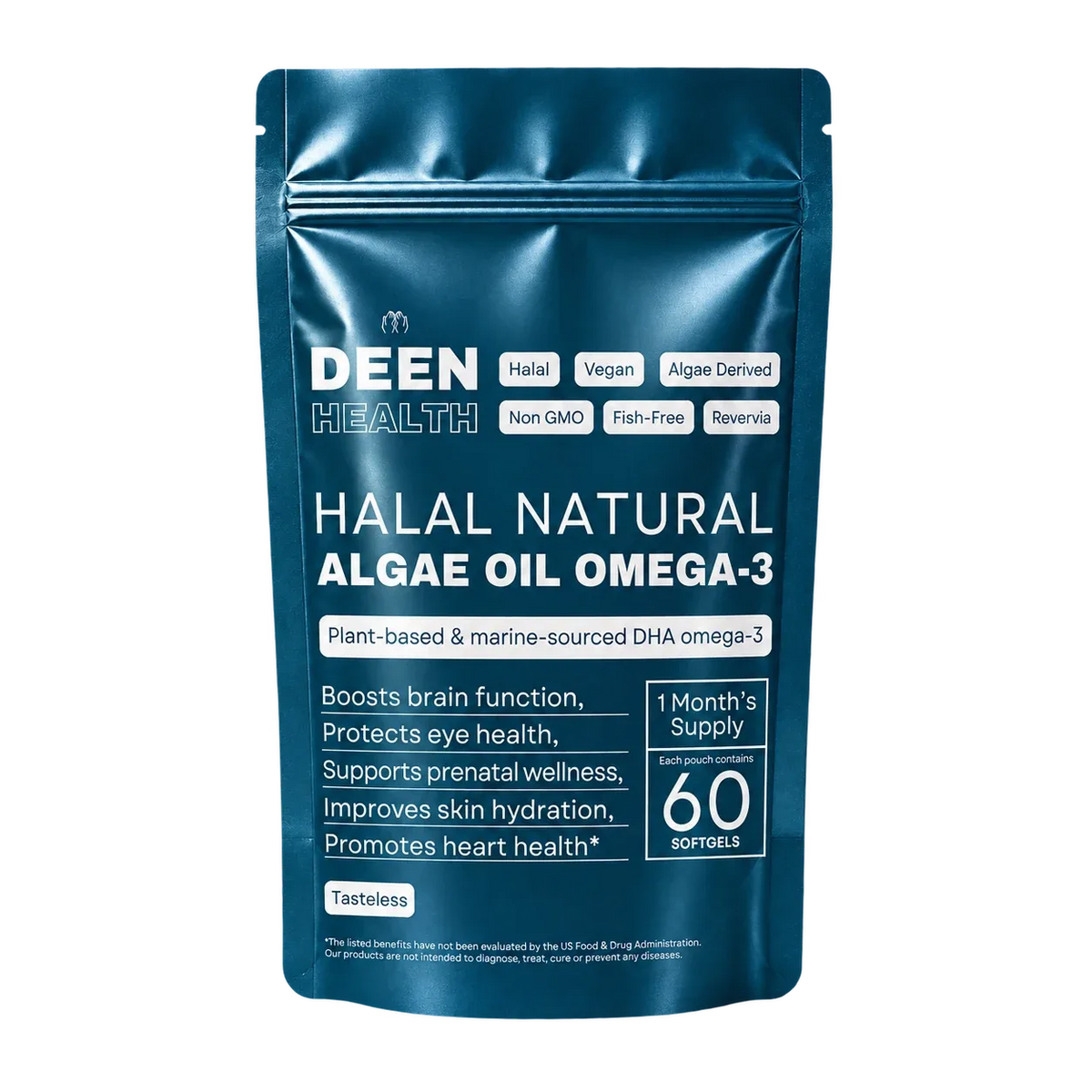
Two softgels provide 500mg DHA from 1,250mg Revervia® algae oil. The total oil and the DHA it provides are different amounts—we show both.

Take them with water, preferably alongside a meal. Breakfast or dinner: choose the one you’ll remember.

500mg DHA · 2 softgels daily · 30 servings per pouch

Regular nutrition is how you care for the systems that keep showing up for you, every day.

A note from Syed

Good nutrition should fit your faith.

Syed Rizvi, founder of Deen Health

Syed RizviFounder, Deen Health

“We knew omega-3 deserved a place in daily care. Then we discovered some supplements used non-halal gelatin in their casings.

So we checked the whole formula. Algae-derived DHA, a plant-based shell, and no gelatin. You deserve to understand why you’re taking it—and trust every part of it.”

Daily nutrition, with a clear purpose

Deen Health Omega-3 pouch

Omega-3

Make room for daily DHA.

DHA for normal brain function and vision, with long-chain omega-3 nutrition for your heart. From algae. Made for your daily routine.

500mg
DHA daily
2
Softgels daily
30 days
In every pouch

Halal · Vegan · Gelatin-free

Explore Omega-3
Before you begin

Check the full ingredient list for allergies. Speak with your clinician before use if you’re pregnant, breastfeeding, taking blood thinners, have a bleeding condition or are preparing for surgery. Follow the product label.